Overview
Royal Palace museum
1000 Years of Wroclaw
Plan a history walkLocate your stop
Map of 46 stops
Select a route, then tap a marker or stop to see its note and open Google Maps.
The 1000 Years of Wroclaw exhibition: 25 halls, over 3000 objects.
Google MapsPainted for Lviv in 1894, shown in Wroclaw since the 1980s; PLN 50 normal.
Google MapsA woman carrying books, made in 1998 for those who fought the flood of 1997.
Google MapsBadly damaged in the spring of 1945, during the siege.
Google MapsA dozen life-size bronze figures descending under the pavement.
Google MapsMeeting point of the Third Reich and World War Two walking tour.
Google MapsExhibition on the city in 1945-2016, in the depot where local Solidarity began in 1980.
Google MapsMax Berg's concrete hall of 1913, on the UNESCO list.
Google Maps
Wroclaw's main railway station, south of the Old Town.
Google MapsThe main bus station, beside the railway station.
Google MapsWroclaw's airport, west of the city center.
Google MapsMeeting point of this site's walking tour; the statue came from Lviv and has stood here since 1956.
Google Maps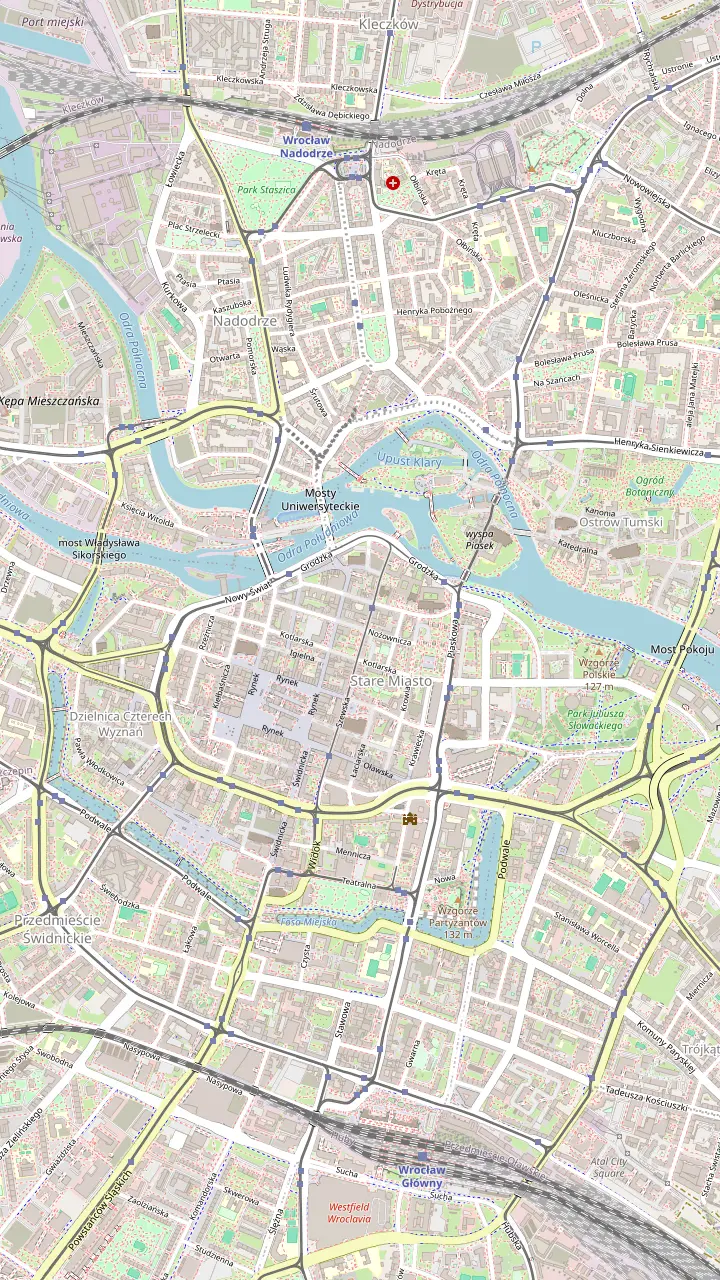
Head of the Dwarf Council, on Swidnicka Street since 1 June 2001, once an Orange Alternative activist.
Google MapsA pair forever rolling a granite ball meant for the street; made in 2005.
Google MapsThe Blind One and the Deaf One, on patrol for architectural barriers.
Google MapsThe kindness dwarf by the fountain; November 21st is his day.
Google MapsThe glutton on a huge plate; rubbing his belly is said to bring luck.
Google MapsBy the Hansel and Gretel houses, near the legendary entrance to the Dwarf City.
Google MapsKeeps watch in Jatki, the old butchers' lane; among the first figures of 2005.
Google MapsBehind bars in Wiezienna Street, by decision of the Dwarf Council.
Google MapsPole climbers peering down from the lamp posts of Salt Square.
Google MapsKeeper of the Ossolineum's books, by the railing in the Ossolinski alley.
Google MapsThe Oder Washer, hero of the flood legend, at the water's edge by the Sand Bridge.
Google MapsOnce worked at the Maria Mill; lives near Tumski Bridge.
Google MapsThe Tumski Lamplighter, keeping the island's lights on.
Google MapsDwarf maps, souvenirs and gifts, right next to the Town Hall tower.
Google Maps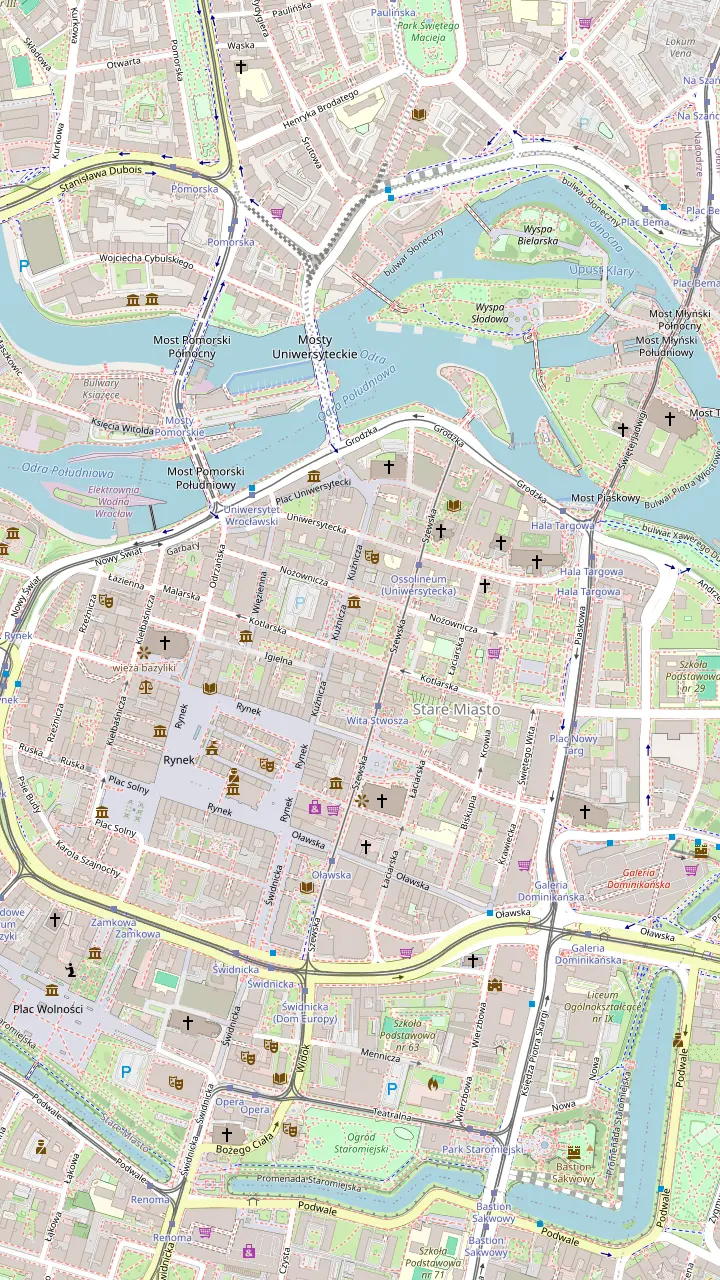
Meeting point of this site's walking tour; the statue came from Lviv and has stood here since 1956.
Google MapsOldest part from 1299; the Museum of Bourgeois Art inside has free permanent exhibitions.
Google MapsIn the House Under the Golden Sun; open Tuesday to Sunday, 10am-5pm.
Google MapsA smaller square; its building at number 4 came through the war almost unharmed.
Google MapsGothic church with a viewpoint at 75 m, reached by stairs.
Google MapsThe Aula Leopoldina, built 1728-1732; closed on Wednesdays, about PLN 28.
Google MapsOn University Square since November 1904.
Google MapsThe library that came from Lviv; open Monday to Friday, 09:00-18:00.
Google MapsBuilt 1226-1232; the Penitents' Bridge at 45 m, 247 steps up.
Google MapsBuilt 1908-1909 on parabolic arches; Monday to Saturday, 8:00-18:30.
Google MapsCast in 1902, lost in 1945, back on the square since June 18, 1998.
Google MapsAt Rynek 14; Monday to Saturday, 09:00-19:00.
Google Maps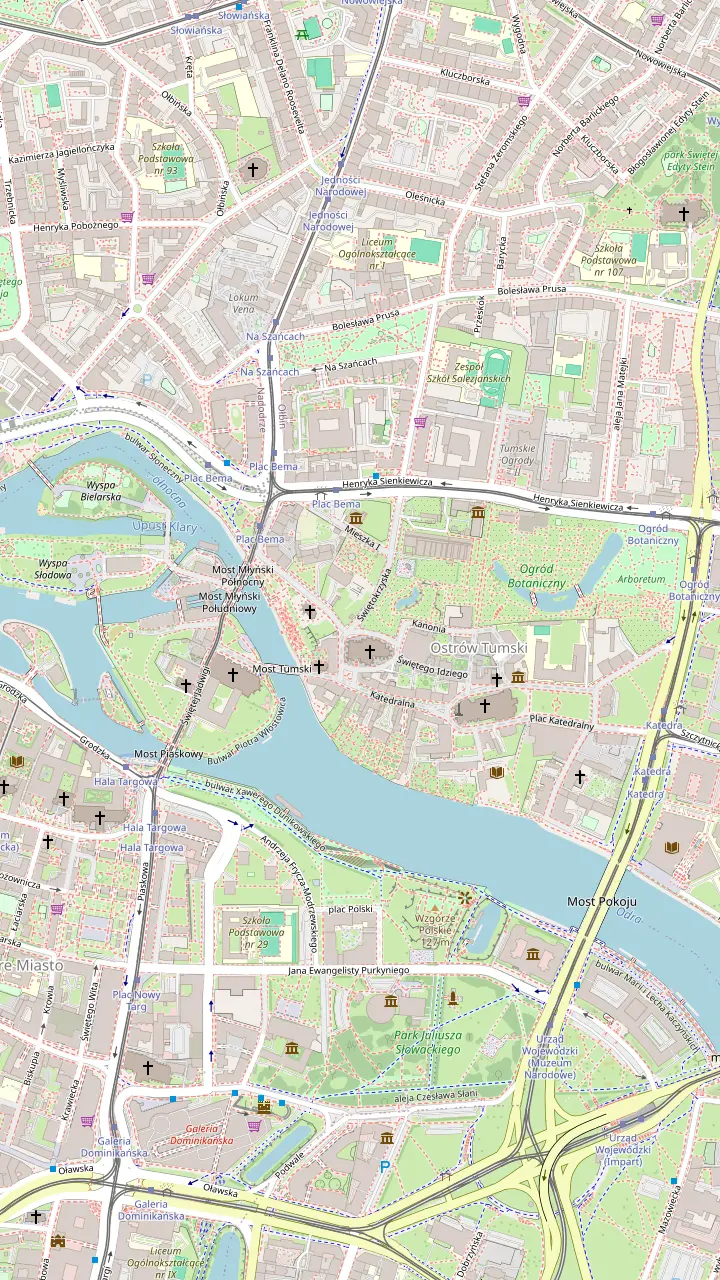
The crossing to Sand Island and the boulevard to Tumski Bridge.
Google MapsGothic church on Sand Island, by the boulevard.
Google MapsThe Bridge of Love, its turquoise railings heavy with padlocks.
Google MapsThe lamplighter passes here at dusk lighting the gas lanterns.
Google MapsA remnant of the Silesian Piasts' castle, the best preserved part of it.
Google MapsChurch on the way from the cathedral to the botanical garden.
Google MapsFree to enter; tower at 97 m by elevator, PLN 25 normal.
Google MapsLate Romanesque church from the early 13th century.
Google MapsFounded in 1811; open daily 1 April to 31 October.
Google Maps© OpenStreetMap contributors, map data
How to pronounce Wroclaw in a few seconds, then the longer story: Czech, German and Polish rule, the siege of 1945, the people who came from Lviv, and the flood of 1997.
Editorial team, wroclawwalkingtour.quest · Updated November 9, 2026 · 8 mins to read
Basics
Here is how to pronounce Wroclaw without embarrassment. The Polish spelling is Wrocław, with a barred L, and a few letters do all the work. The opening W sounds like an English V. The C is said like the ts in cats. The barred L, ł, is spoken like an English W. Put together and said quickly, you get something close to VROTS-wahf, with the weight on the opening part. The final W softens toward an F because it ends the word, which is normal in Polish.
The most common English attempts, ROCK-law or ROSS-law, will still get you understood at a hotel desk, but locals smile at them. Try VROTS-wahf at the station or in a cafe and you will usually be answered in kind. The walking tour this site sells even lists the confusing name and how to say it among its themes, so you can practise with a local guide. Once you hear it said a few times, it sticks.
The German name is Breslau, and you will meet it everywhere in the city's history, in old postcards, on the plaques of buildings and in museum labels. The old Latin form, Wratislavia, lives on in the name of Wratislavia Cantans, the city's major music festival.7 All of these names point to the same place on the Oder. Which one a source uses usually tells you which century, and which state, it was written in.
Say it right
| Letter | Sounds like | Example |
|---|---|---|
| W at the start | English v | VROTS |
| C | ts, as in cats | VROTS |
| Ł, barred L | English w | wahf |
| W at the end | close to f | wahf |
A simplified English guide; Polish speakers run the sounds together. The listing of this site's tour names the pronunciation among its themes.
Is Wroclaw the same as Warsaw? No, and the mix-up is common, partly because both names begin with a W. Warsaw is the national capital in central Poland, on the Vistula. Wroclaw is the capital of the Lower Silesian province in the south-west, on the Oder.1 The city lists 12 islands and 112 bridges inside its limits, which gives it a very different feel from Warsaw's long riverbank.2
The two cities also have very different stories. Wroclaw was long the German city of Breslau, and its University, for example, has a Polish history that began only in 1945, as the next sections explain, and much of its population arrived only after the war.14 Wroclaw celebrated its millennium in 2000 and was a European Capital of Culture in 2016, together with Donostia-San Sebastian.15,16
If you are planning a trip that covers both cities in one journey, our page on getting to Wroclaw covers trains and buses from Warsaw. In Wroclaw itself the center is compact: the Market Square, the University and Ostrow Tumski sit within walking distance of each other, which is why a guided walk works so well here. A guided group walk here takes 2.5 hours and starts from €17.
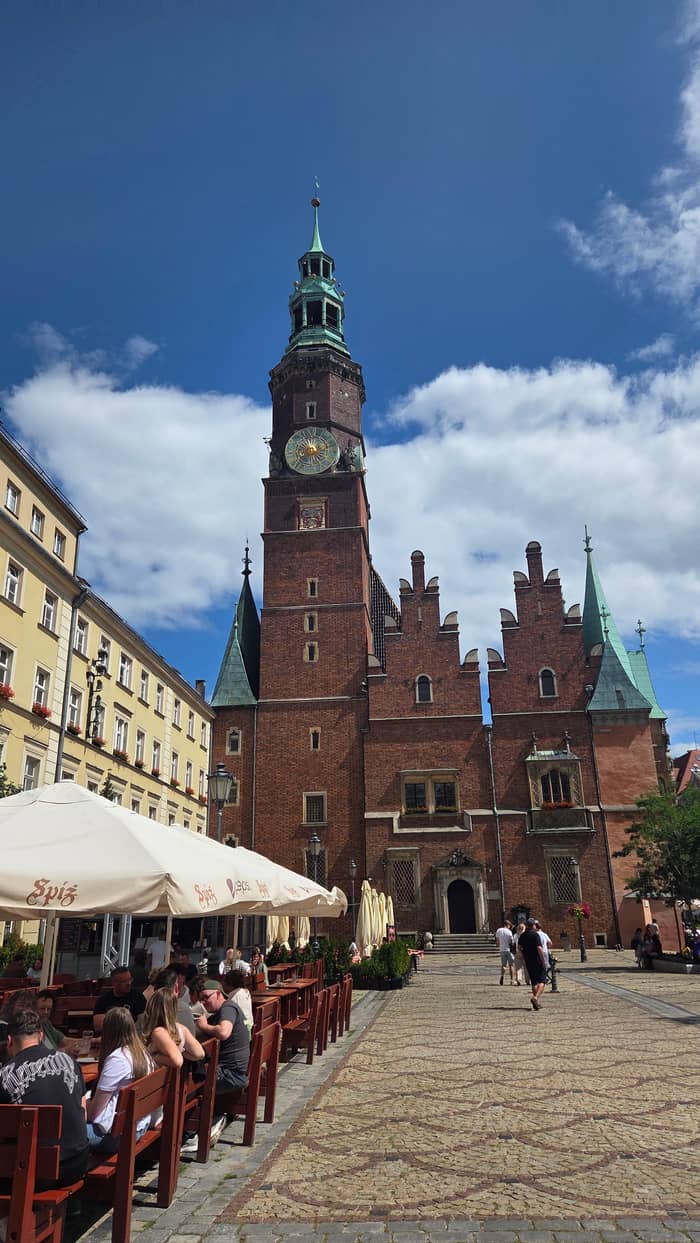
According to the Polish Tourism Organisation, Wroclaw started as a 10th-century stronghold on the island of Ostrow Tumski.8 The City Museum's history exhibition starts its account with the founding of a bishopric in the year 1000.26 For centuries the region was ruled by the Silesian Piasts. A castle history on the city's portal notes that the last Wroclaw Piast, Henry VI, died in 1335, after which the estate passed to the Crown of Bohemia.9,10
Later came the Habsburgs, the dynasty that ruled from Vienna. Emperor Leopold I founded the academy that grew into the University in 1702, and its great hall, the Aula Leopoldina, built in 1728-1732, still carries his name.11,27 In 1742 Prussia seized Silesia.12 The Royal Palace in the city center served as a residence of the Prussian Hohenzollern rulers in 1750-1918, and it has been a museum since 1926.28
Under German rule Breslau grew into a large modern city. The Polish Theater dates from 1906, a time when Breslau belonged to Germany.29 Centennial Hall, a monumental concrete building by Max Berg dating from 1913, is now on the UNESCO list.30 The Polish Tourism Organisation sums it up neatly: Wroclaw shows visible reminders of Czech, German and Polish rule.3 Walk the center with that in mind and the mix of styles makes sense.
Choose your history
Pick the era you care about and the way you like to learn.
If I want the whole story in a morning
The Royal Palace exhibition
If I want the war years with a guide
The WW2 walking tour
2 hours from the Monopol Hotel in English.
If I want the postwar city
Depot History Centre
Its exhibition covers 1945-2016.22
If I want art with a story
Raclawice Panorama
Painted in Lviv, shown here since the 1980s.25
If I want an easy first walk
The Old Town and Ostrow Tumski walk
2.5 hours, including how to say the name.
History stops
Overview
1000 Years of Wroclaw
Plan a history walk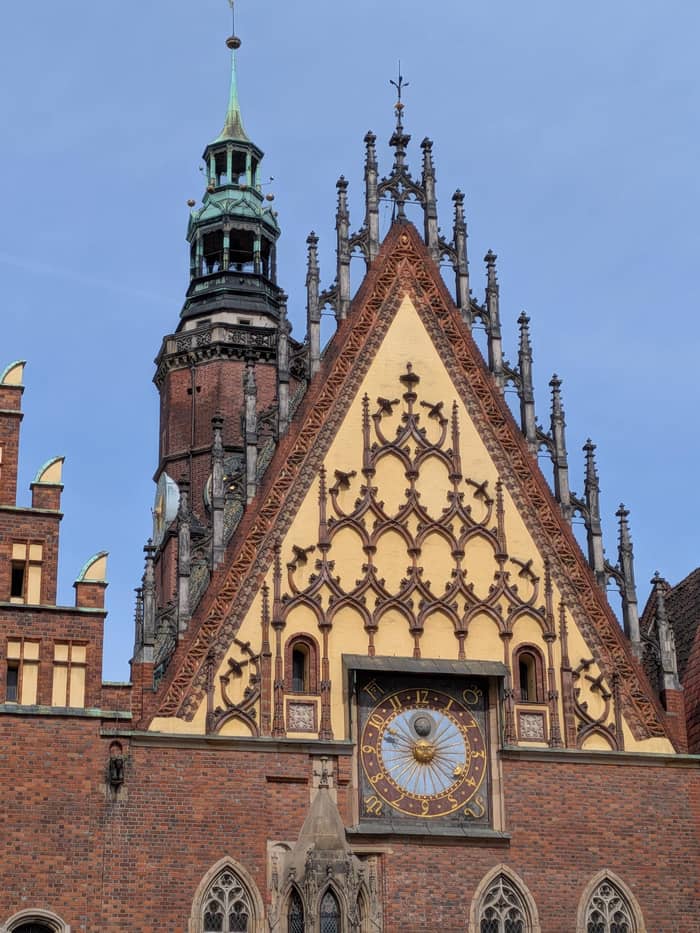
Postwar years
Wroclaw 1945-2016
Plan a history walk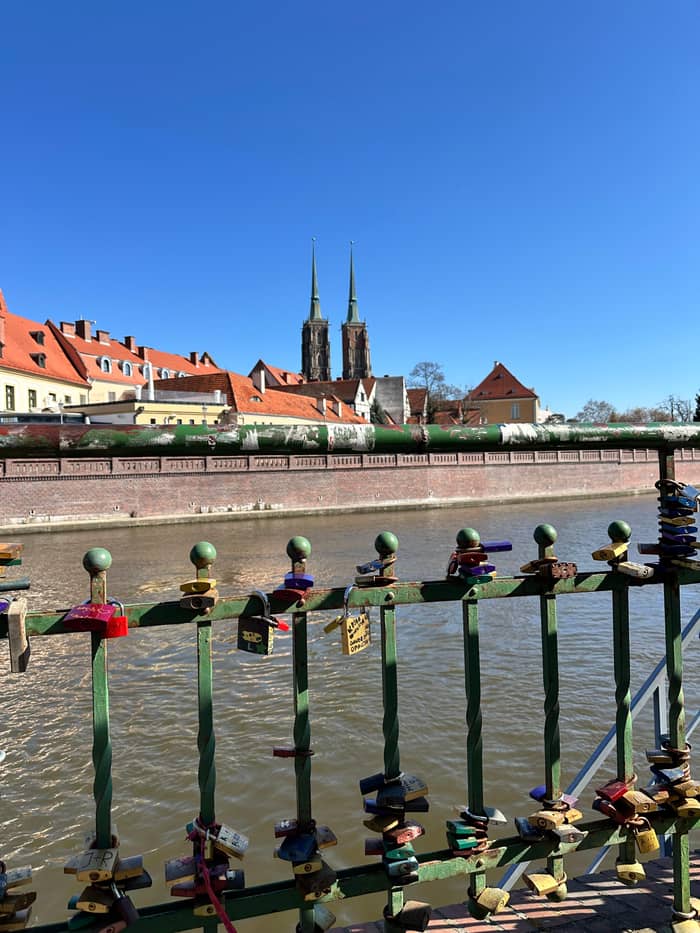
Painting
From Lviv to Wroclaw
Plan a history walkThe Second World War struck Breslau's Jewish community years before the front line arrived in the city. On Salt Square, the Oppenheim House had been an important center of Jewish life; in 1941 the Nazis seized it and deported its Jewish residents to the East.88,89 The oldest trace of the community, a gravestone of a man named David who died in 1203, was found in the cathedral in 1917.90
In the spring of 1945 the city, held as Festung Breslau, was besieged, and the cathedral was 70 percent destroyed in the fighting.4 In St Mary Magdalene, ammunition stored in the south tower exploded, destroying the tower.91 Grunwald Bridge was badly damaged, and buildings were torn down at today's Grunwald Square to make room for an airfield inside the besieged city.84,92 The building of today's Polish Theatre chamber stage was destroyed completely.93
Small objects carry the same story. The bronze bear fountain by the Town Hall, put up in 1904, was lost during the fighting and returned only in 1998.67,68,69 The Oppenheim House on Salt Square is among the few Old Town buildings to come through the bombing almost unharmed.57 When you see a perfect Gothic or Baroque facade, remember that much of what you see was rebuilt after 1945, often over many years: the cathedral only became usable again in 1951.4,94
Price a history walk
Select a walk, then add the people in your party.
Compare 3 alternatives
Select a walk, then add the people in your party.
≈
View≈
View≈
ViewThese from-prices come from GetYourGuide and are converted using the ECB reference rate; the exact price shows at checkout.
Wroclaw through the centuries
10th century
A stronghold on the island is where the city began.8
1335
The last Wroclaw Piast dies; his estate passes to Bohemia.9,10
1702
Emperor Leopold I founds the Leopold Academy.11
1742
Prussia seizes Silesia.12
1945
The siege leaves the cathedral 70 percent destroyed.4
1997
The Oder peaks on July 12 and 13.13
After the war the city's people changed. The Depot History Centre, set in a former bus depot, tells that story in its exhibition on the years 1945-2016, covering the exchange of population after the war and the rebuilding of the city.22 Many of the new residents came from the former eastern borderlands.95 The Fredro monument on the Market Square says it in bronze: unveiled in Lviv in 1879, it has stood in Wroclaw since 1956.96,52
The city's portal notes that many Lvivians settled here after 1945.5 They brought institutions with them. The Ossolineum library was founded in Lviv in 1817; about 11,000 manuscripts and prints were evacuated in 1944, and the collection reached Breslau in 1947.97,98,6 In 1946-1947 a further 217,450 volumes were sent from Lviv, yet about 70% of the library's pre-war holdings stayed there.99,100
The Raclawice Panorama made the same journey. It was painted for an exhibition in Lviv in 1894 and has been shown in Wroclaw since the 1980s.24,25 The University's Polish history also began in 1945, and the first lecture in Polish was given by Ludwik Hirszfeld on 6 September that year.14,101 The Ethnographic Museum shows the culture of settlers from Lviv, Ternopil, Vilnius and other borderland towns.95
Video
ExpatPolska on YouTube · Playback files load only once you tap play.
the exchange of population after World War II, the reconstruction of the city from war damage
Before your history day
Postwar Wroclaw soon wrote chapters of its own. The bus depot that now houses the Depot History Centre is where the city's Solidarity movement was born in 1980.23 In the 1980s the painted dwarfs of the Orange Alternative appeared on Wroclaw's walls to mock communist rule, which is why the city's famous bronze dwarfs trace back to a protest.102,103 Our page on the dwarfs tells that part of the story.
The defining event for many residents is the flood of July 1997. A cross by the Trzebnickie Bridges marks the level the Oder reached on July 12 and 13, 1997.13 Hundreds of people worked through the crisis to build defences on the Sand Island boulevard to protect the University Library's most valuable collections, and volunteers carried books out of the library's stores on Szajnochy Street.104,105
The city remembered with a statue. Powodzianka, a woman carrying books on her shoulder, stands on University Bridge; she was made in 1998 as a tribute to the residents who fought the flood.83 Even the dwarfs joined in: legend says Pracz Odrzanski, the Oder Washer, spotted the rising water first and filled his cap with sand.45 Look for both on a walk between the University and Ostrow Tumski.
If you want the twentieth century told on foot, a dedicated Wroclaw WW2 walking tour exists: the Third Reich and World War Two tour lasts 2 hours, meets outside the Monopol Hotel and has a live guide in English. A private tour on Breslau and the war, in Polish and German, covers Salt Square, plac Wolnosci and the Monopol Hotel. Our own group walk weaves the story of the city's name into its Old Town route.
For a museum day, the 1000 Years of Wroclaw exhibition in the Royal Palace gives a broad overview, with 25 halls, over 3000 objects and audio guides in Polish, German or English.26,20,21 Most museums in the city close on Mondays, so plan your museum day around that.86 The Raclawice Panorama costs PLN 50, or PLN 35 reduced, and the ticket also opens several National Museum branches within 3 months.17,87
Treat the war and the exchange of population with the seriousness they deserve. The rebuilt facades and the names of streets and institutions all mark a period of great loss for the people who lived here before 1945 and for those who arrived afterward.5 Walking with that in mind changes how the bright Market Square looks. Our map above links the history stops, from the Royal Palace to the Depot History Centre.
FAQ
The W sounds like V, the C like ts, and the barred L like an English W.
Warsaw is the national capital; Wroclaw is the capital of Lower Silesia, on the Oder.1
The Polish Theater, for example, was founded in 1906, when Breslau was German territory.29
The fighting that spring left the cathedral 70 percent destroyed.4
It meets outside the Monopol Hotel, from €30.
A cross by the Trzebnickie Bridges marks the level of July 12 and 13, 1997.13
Sources
New to Wroclaw? Ask a real person about the walk.